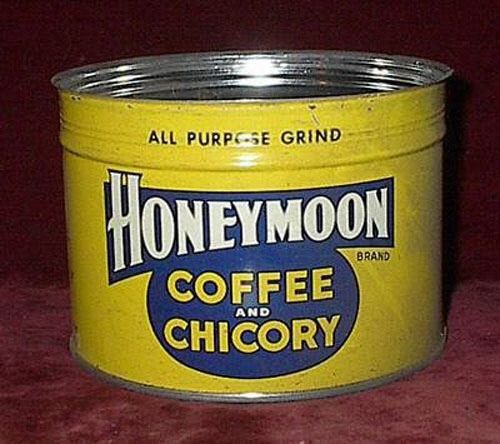
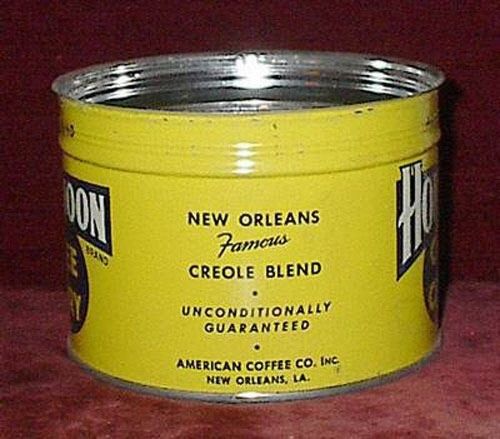
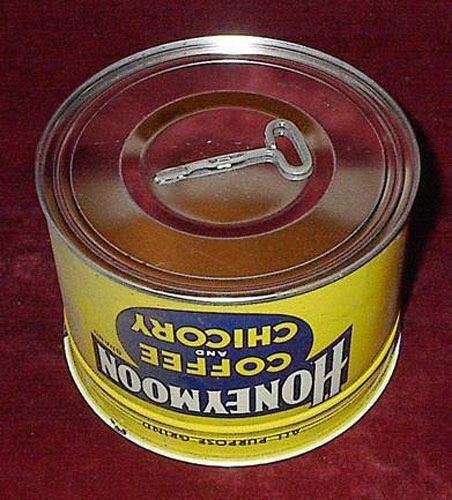
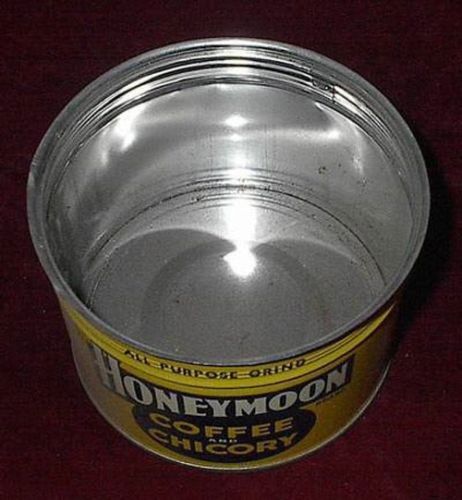
Rare HONEYMOON COFFEE & CHICORY NEW ORLEANS 1 Lb. ADVERTISING TIN ~ CREOLE BLEND ↓ ↓↓SCROLL DOWN TO VIEW ALL PHOTOS ↓ ↓↓ ///////////////////////////////////////////////////////////\\\\\\\\\\\\\\\\\\\\\\\\\\\\\\\\\\\\\\\\\\\\\\\\\\\\\\\\\\ THIS MONTH, WE ARE PLEASED TO OFFER MANY FINE ANTIQUE AND -ARTIFACTS AND RARITIES FROM MISSISSIPPI AND LOUISIANA ESTATES AND PRIVATE COLLECTIONS PLEASE CHECK OUR OTHER EBAY LISTINGS FOR MORE EXAMPLES OF EARLY ANTIQUES & COLLECTIBLES ///////////////////////////////////////////////////////////\\\\\\\\\\\\\\\\\\\\\\\\\\\\\\\\\\\\\\\\\\\\\\\\\\\\\\\\\\ DESCRIPTION THIS RARE EXAMPLE, QUITE HARD TO FIND, MEASURES 5" IN DIAMETER AND 3.5" TALL, BEING A 1 POUND VACUUM PACK STYLE TIN, APPEARING TO HAVE NEVER BEEN SEALED, WITH A SHARP TOP RIM FLANGE. A BILLBOARD ADVERTISING STYLE LOGO IN DEEP BROWN, READS HONEYMOON Brand COFFEE AND CHICORY REPEATED ON THE FRONT AND REAR. OTHER LETTERING READS NEW ORLEANS FAMOUS CREOLE BLEND ~ UNCONDITIONALLY GUARANTEED ~ AMERICAN COFFEE CO., INC. ~ NEW ORLEANS, LA. ALONG WITH ALL PURPOSE GRIND ~ VACUUM PACKED ~ ONE POUND NET. LETTERING. ON THE UNDERSIDE, THE KEY OPENER IS AFFIXED AND INTACT. THE AMERICAN COFFEE COMPANY WAS FOUNDED IN 1890 AND BEGAN OPERATIONS IN NEW ORLEANS AT 423 SOUTH PETERS STREET. THEIR FIRST BRAND OFFERED WAS FRENCH MARKET COFFEE. OVER THE YEARS AMERICAN'S BRANDS HAVE INCLUDED ST. CHARLES, HONEYMOON, FRENCH OPERA, TULANE, POINTER, FRENCH MARKET, DIXIELAND, LOYOLA, AND MONTELEONE. AFTER ACQUIRING THE NEW ORLEANS COFFEE COMPANY IN 1934 AND MERCHANTS COFFEE IN 1950, THE COMPANY ENSURED ITS PLACE IN STORES AROUND THE REGION. UNTIL RECENTLY, THE COMPANY CONTINUED TO ROAST, ON LOCATION, SUCH POPULAR BRANDS AS UNION AND FRENCH MARKET COFFEE AT THEIR 800 MAGAZINE STREET LOCATION, AND PROVIDED COMMERCIAL GRADES FOR LOCAL RESTAURANTS AND BUSINESSES UNDER THE LABEL ALAMEDA. COFFEE ROASTING AT THE MAGAZINE STREET LOCATION HAS CEASED, AND THE FIRM HAS NOW CLOSED THE DOORS, SELLING ALL THE REMAINING BRAND NAMES, WITH SOME CONTINUING TO BE OFFERED UNDER THE ORIGINAL NAME, BUT BY A NEW DISTRIBUTOR. SUPERB, VINTAGE CONDITION, BEING A LITTLE DUSTY AND DIRTY, AS FOUND ~ BEST NOTED BY EXAMINING THE IMAGES OFFERED. HISTORY OF COFFEE TINS There are many categories of coffee tins that exist: pre-1901 two color, decorated metal box variety, paper label over tin or cardboard, key or strip open types, pail, coffee bins and the tall cylindrical lithographed tin one-pound containers. The lithographed one-pound tin was introduced on the 1880s although coffee had been packed in tin since the early 1800s. The labels on these early tins were either soldered embossed or stenciled. Pre-1901 the tins were not of uniform size. They were square, cylindrical, rectangular or box-shaped with a small pull-off or hinged lid. 1901 was the year that most of the early lithographic companies were bought out by the American Can Company. The pre-1901 tin will usually have the tin makers name on the label. There were only two colors in the lithography process, usually black with either red, green, yellow or blue, or a shade of one of these colors. By 1914, multicolored tins began to be mass produced using techniques of chromatography. Since the containers could sell the coffee the more exquisite the label the better the product would sell. The 1920s brought about keen competition for the coffee seller and a variety of different sized containers became available. It is known that at least 350 different brands in tall, lithographed one-pound tins existed and 1,100 short key-open tins. As the hobby grows more unknown tins pop up. Paper label containers probably exist in even greater numbers. Many of the multi-colored paper labels are just as exquisitely detailed if not even more so than tin and much less expensive in todays market. The tall one pound containers have two basic types of lids: the pry-off type which is inset in the top about 1/4 inch from the edge the twist-off which fits over the top and twists down. These lids were introduced with the start of air-tight coffee containers after the turn of the century. This type of container allowed the coffee to stay fresh longer. In the late 1920s the key-open tin was introduced and a true vacuum seal was created. The tall one-pound tin disappeared in the art Deco Period of the early 30s and was totally replaced by the key-open tins and glass containers and in some cases paper bags. Tins are still showing up but with less and less regularity. HISTORY OF NEW ORLEANS COFFEE, CHICORY & CREOLE BLENDS As with other tropical commodities, coffee did not become widely available outside of wealthier domains until the establishment of slavepowered coffee plantations in the Americas. The French established their plantations in the West Indies during the late 1600s and early 1700s. Successfully cultivated in Martinique about 1720, coffee was brought by the French to their new colonies. This included New Orleans, founded only two years before. Haiti soon followed and, from the 1730s until the slave uprising in 1791, it supplied fifty percent of the worlds coffee and forty percent of its sugar. After all that tea unpleasantness in Boston Harbor, and his visits to France, Thomas Jefferson called coffee the favorite drink of the civilized world. By 1815, the word caf was beginning to replace coffeehouse, in large part due to the young nations acquisition of New Orleans with the Jeffersons Louisiana Purchase. So what brought about the New Orleans famous pairing of coffee with chicory? Chicory grows in Europe and North America as a wild perennial plant with blue, lavender, or some times white flowers. In the United States and France it is known as curly endive (Chicorium endivia). Endives are used for salad, but it is the chicory root that is used as a coffee additive. The chicory plant has been cited in the earliest recorded literature. Horace touts it as a major component of his diet when he writes, Me pascant olivae, me chicorea, me malvae (As for me, olives, endives and mallows provide sustenance). But how New Orleanians came to drink chicory with their coffee had much more to do with Admiral Horatio Nelson and Union General-in-Chief Winfield Scott. Lord Nelsons dominance of the sea during the Napoleonic wars impeded the importation of coffee into France, so chicory often appeared as either a coffee substitute or an adulterant. The same thing happened in the Crescent City during the Civil War. The Union blockade of the port of New Orleans (implemented as part of General Scotts Anaconda Plan) led to the sudden scarcity of coffee and other commodities. So just as the French did, New Orleanians added ground, roasted chicory root to stretch their limited stock of imported coffee. The chicory, grown locally as a wartime measure, moved from the realm of temporary fix due to scarcity to the embracing of the chicory blend on a permanent basis. Its smooth texture and comforting caramel-like flavoring helped coffee with chicory become and continue to be a local favorite. The New Orleans City Guide compiled by the Federal Writers Project of the WPA informs us that Creole coffee is a mixture of pure coffee and about twenty per cent chicory. Coffee has always been serious business in New Orleans, being a major port for Latin American trade. But besides the stacks of sacks on the port docks, locals have always enjoyed this stimulating brew. Coffee shops are not just a modern phenomenon in this Starbucks age. Even in the decade before the Civil War, there were over 500 coffeehouses in the city. Today, it is estimated that one-third of all coffee imported into North America makes a stop through the port of New Orleans. Folgers Coffee (now a division of jelly giant, the J. M. Smucker Company) operates the worlds largest coffee roasting plant a few miles down the Mississippi from the French Quarter. Some dozen local roasters, including Folgers, import an average 250,000 to 300,000 tons of coffee beans annually through the port. So important is coffee to New Orleans, President Bush visited Folgers plant in September 2005 right after Katrina. Folgers had sales in 2007 totaling $1.6 billion. Local roasters prepare products for some twenty local and national brands. Many like their coffee black (like the young girl in Airplane), but Caf au lait is an immensely popular New Orleans favorite. This custom began in Vienna when the military obtained huge quantities of beans from the defeated Turkish army and then set up shop. Adding milk and sugar to coffee is believed to have originated with a Polish-born army officer named Franciszek Kulczycki, who opened the first Viennese coffee establishment. CafDu Monde (CDM) coffee (since 1862) is traditionally served au lait (mixed with half coffee and half hot milk) and beignets. One can even get mocha added there now. William B. Reilly founded the company that produces CDM Coffee, believing New Orleans would be an ideal place to set up a coffee roasting and grinding business. The company that began in 1902 now produces not only coffee, but a vast array of products. Morning Call was the other great French Quarter coffee stand on Decatur, where debs and dates or parents, with kids in their pajamas, could drive up for beignets and coffee. Founded by Joseph Jurisich in 1870, it moved to Jefferson Parish in 1974. Community Dark Roast Coffee, owned by the Saurage family, is popular with New Orleanians, and today there are CCs throughout the city. From 1957 to 1961, Jim Henson made lightning-fast humorous television commercials with his muppet-like characters for Community and other coffee companies. They were a huge success and bolstered his career. In 1890, French Market Coffee & Chicory was first roasted, blended and packaged in New Orleans. A century ago, there were some twenty-four coffee dealers in the city, including Merchants Coffee Company. Merchants merged in 1986 into the American Coffee Company (at 800 Magazine Street since 1941), which produces French Market and Union Coffee. New Orleans author and food critic Tom Fitzmorris recommends Union Coffee and Chicory as his preference. There are so many favorite coffee brands and shops in the New Orleans area. Phyllis Jordan opened the first PJs on Maple Street in 1978 and others followed. Theres Rue de la Course, Royal Blend, Croissant dOr, CafBeignet, VooBrew and Nola Beans, to name just a few. ///////////////////////////////////////////////////////////\\\\\\\\\\\\\\\\\\\\\\\\\\\\\\\\\\\\\\\\\\\\\\\\\\\\\\\\\\ PLEASE USE THE EBAY "CONTACT SELLER" FUNCTION TO CONTACT US AND RESOLVE ANY QUESTIONS BEFORE BIDDING FREE SHIPPING ON THIS ITEM TO DOMESTIC ADDRESSES INTERNATIONAL SHIPPING AVAILABLE ~ CONTACT US FOR A RATE QUOTE BEFORE BIDDING
By clicking "Accept All Cookies", you agree to the storing of cookies on your device to enhance site navigation, analyze site usage, and assist in our marketing efforts.